The US hotel industry enters 2026 in an unusual position.
Demand remains relatively stable. Revenue is still growing. Major events are creating new opportunities across several markets.
Yet many hotel owners and finance teams are feeling a different reality.
Margins remain under pressure. Labor costs continue to rise. Operating expenses remain elevated. And in many cases, revenue growth is barely keeping pace with the costs required to generate it.
That makes 2026 a year where financial discipline matters as much as operational performance.
The RevPAR Picture
At first glance, the outlook appears stable.
Industry forecasts project moderate RevPAR growth in 2026, driven primarily by ADR increases rather than occupancy gains. Occupancy levels remain relatively flat, while room rates continue to do most of the heavy lifting.
That's an important distinction. For several years, hotels benefited from demand recovery following the pandemic. In 2026, that recovery story is largely behind us. The focus has shifted to pricing power.
The challenge is that expenses continue to grow as well. Industry analysts expect operating costs to remain elevated, keeping profitability under pressure despite top-line growth.
The headline numbers may look healthy. The margins underneath them require much closer attention.
The FIFA World Cup: A Demand Spike With Accounting Stakes
The 2026 FIFA World Cup is expected to be one of the largest sporting events ever hosted in North America.
Matches will take place across 16 host cities, including New York, Los Angeles, Dallas, Miami, Seattle, and San Francisco.
For hotels in host markets, the event represents a significant revenue opportunity. But increased demand creates financial reporting challenges as well.
Hotels may encounter dynamic pricing adjustments, high-volume group bookings, temporary OTA contract variations, increased cancellation activity, and complex revenue allocation across booking channels.
A hotel that experiences a sharp increase in bookings still needs accurate revenue recognition. The distinction between OTA merchant-model bookings and agency-model bookings becomes far more important when transaction volume spikes.
Finance teams relying solely on month-end reconciliation may struggle to identify reporting issues quickly enough. For many properties, the World Cup will be as much a test of financial infrastructure as it is a test of operational capacity.
The Wage Number: $131 Billion and What It Means
Hotel wages and benefits are projected to approach $131 billion in 2026.
That number highlights a reality every hotel operator already understands. Labor remains the industry's largest expense category. And it isn't getting smaller.
As wages continue to increase, payroll-related tax planning becomes more valuable. One area that remains frequently overlooked is the FICA tip credit under IRC Section 45B.
For full-service hotels with substantial tipped payroll, this credit can generate meaningful tax savings. A property with significant restaurant, banquet, and food-and-beverage operations may be eligible to recover a substantial amount through proper Form 8027 reporting and reconciliation.
The problem is that many hotels either undercalculate the credit or fail to maximize it altogether. As tipped wages rise, so does the value of getting this calculation right.
The K-Shaped Market
Not every hotel segment is experiencing 2026 the same way.
Higher-end properties continue to benefit from stronger leisure and group demand. Premium and upper-upscale hotels generally have greater pricing power and more flexibility when managing rising costs.
Budget and midscale properties face a different environment. They often operate with thinner margins, less ADR flexibility, and higher labor costs relative to revenue.
From a finance perspective, these differences matter. A full-service urban hotel evaluating a cost segregation study may have very different economics than a limited-service suburban property. Treating every hotel the same can lead to missed opportunities.
OBBBA: What Changed for Hotel Finance in 2026
Several provisions under the OBBBA have created new planning opportunities for hotel owners.
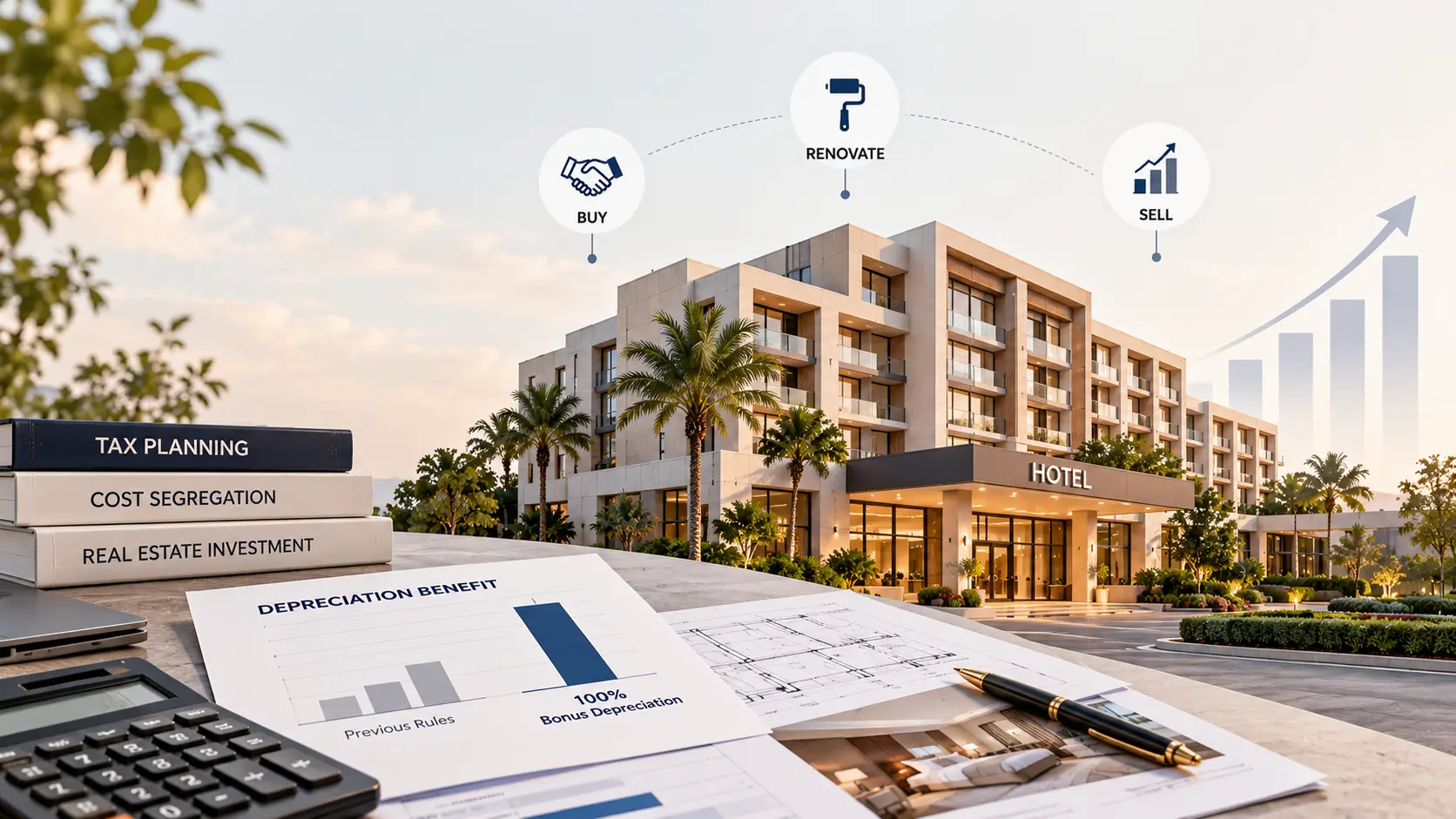
One of the most significant is the restoration of 100% bonus depreciation for qualifying assets placed in service after January 19, 2025. For hotels investing in renovations, furniture, fixtures, equipment, and other qualifying assets, the first-year tax benefit can be substantial.
The law also provides long-term certainty around the Section 199A Qualified Business Income deduction for eligible pass-through entities. For many hotel ownership structures, that predictability improves tax planning.
Additional changes include new W-2 reporting requirements for certain tips and overtime compensation, an increased Form 1099 reporting threshold beginning in 2026, and simplified reporting obligations for some vendor relationships.
The opportunity is real. But these benefits only help properties that plan before year-end.
What the 2026 Environment Requires From Hotel Finance Teams
The hotels that perform best financially in 2026 will not necessarily be the ones with the highest occupancy. They will be the ones with the strongest financial visibility.
That means real-time P&L reporting instead of month-end surprises, accurate tracking of tipped wages, overtime, and service charges, proactive tax planning before year-end, proper evaluation of cost segregation and bonus depreciation opportunities, and USALI-structured financial reporting that supports lenders, investors, and future transactions.
The margin for error is smaller than it was a few years ago. Finance teams need timely information to make timely decisions.
Conclusion
The 2026 hotel market is not facing a demand problem. It's facing a margin management challenge.
RevPAR growth remains modest. Labor costs continue to rise. Major opportunities such as the FIFA World Cup and expanded depreciation benefits create upside, but only for operators prepared to capture them correctly.
The hotels that outperform this year won't simply generate more revenue. They'll have stronger reporting, better tax planning, and clearer financial visibility.
At GoalSeek, we provide accounting, bookkeeping, and tax preparation services built specifically for hotel owners and the CPA firms that serve them. From USALI-based reporting and FICA tip credit calculations to cost segregation planning and year-end tax preparation, we help hospitality businesses turn accurate financial data into better decisions.